Our Patients:
Easton James David Kieffer
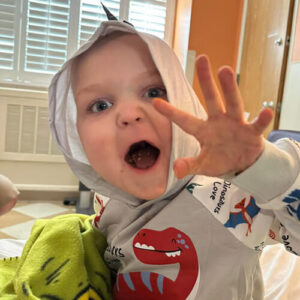
During their 20-week anatomy scan, Kasee and David received news that their unborn son’s heart was very special. Baby Easton had hypoplastic right heart syndrome (HRHS) and Tricuspid Atresia – rare congenital heart defects where the right side of the heart (particularly the right ventricle and tricuspid valve) are underdeveloped. For children with HRHS, the heart cannot adequately pump blood to the lungs. The result of this is an inadequate supply of oxygenated blood to be circulated to the body.
“I lost it,” cried Kasee. “I literally just sat and cried. I couldn’t talk. I didn’t know what questions to ask. I was numb……just numb.”
The remainder of Kasee’s pregnancy was considered very high risk and necessitated weekly appointments, stress tests and ultrasounds at the St. Louis Fetal Care Institute and Dorothy and Larry Dallas Heart Center at SSM Health Cardinal Glennon Children’s Hospital in St. Louis. There is no cure for HRHS, and Easton would need a three-stage series of surgical procedures. The goal of those surgeries, ultimately, is to redirect the blood flow within the heart and allow the left ventricle to do the work for the underdeveloped right side of the heart. The three surgeries would be spread out over his first few years of life. “I had heart surgery at Cardinal Glennon when I was one year old to fix my pulmonary valve. I knew we were in the right place,” said Kasee.
Despite a smooth delivery at SSM Health St. Mary’s Hospital and a healthy birthweight of 9 pounds 9 ounces, Easton required immediate life-saving intervention. The transport team from SSM Cardinal Glennon brought him via ambulance from St. Mary’s to the Level IV Neonatal Intensive Care Unit at SSM Health Cardinal Glennon. David followed the ambulance in his car to get Easton settled, and shortly thereafter, returned to pick up Kasee, who discharged herself from the hospital to be in the NICU with Easton.
Kasee recalls those first few days including everything EXCEPT…the normal joys of being able to hold and comfort their newborn. “There were breathing tubes, feeding tubes, central lines, umbilical lines, medicated drips, echocardiograms and multiple tests – things that I never needed to learn about with my other two children,” Kasee said. “He had his first open heart surgery – the Norwood procedure – when he was only 8 days old. The goal of that surgery was to have a central shunt placed. He got through the surgery and initially did really well – but unfortunately, not too long after that, Easton began experiencing many complications.”
Kasee and David will never forget the night things took an unexpected turn for the worst. “We got a phone call at 3 am one night while we were at home caring for our other two children,” Kasee said. “The cardiologist called, telling us that Easton went into cardiac arrest and was placed on ECMO (Extracorporeal Membrane Oxygenation – a life-saving medical procedure that temporarily takes over the functions of the heart and lungs when they are unable to do so). We were told the unthinkable—that we should come back immediately and that it could possibly be to say goodbye to our son. Kasee and David rushed back to the hospital not knowing what they would walk into when they got there. “Easton had been without oxygen for around 7-10 minutes, resulting in a neurological problem with a small part of his brain,” Kasee said. “He stayed on ECMO for a week and a few days, and as time passed, he got better and better. Miraculously, he was able to go home with us, and we followed up as needed through our appointments at the Heart Center.”
On July 1st, 2021, Easton had his second open-heart surgery, a Glenn procedure. The surgery went well, and Easton was discharged home within 3 days. For the next two years, he was able to stay out of the hospital and just focus on being a kid.
Just a few days before New Year’s Eve, 2024, Easton became sick. He had walking pneumonia and RSV (Respiratory Syncytial Virus) and was treated and sent home. Not long after that, during an appointment with his pediatrician, Easton’s oxygen saturations were low. He was taken in an ambulance to Cardinal Glennon. A series of tests revealed that Easton’s heart was not squeezing and functioning properly, so he was admitted to the hospital for monitoring and medications. Unfortunately, his heart became sicker – not responding to medications as well as expected. His third open-heart surgery was not an option since he was so sick, and he was placed on the transplant list for a new heart.
On February 12th, 2025, Easton suffered cardiac arrest 4-5 times and was placed on ECMO shortly after. His family had him baptized, and the following day, it was decided they should attempt his 3rd open-heart surgery, the Fontan procedure. During this surgery, he had a Ventricular Assist Device (VAD) placed. A VAD is a mechanical pump used to support heart function and blood flow in patients with heart failure. In many childhood cases, they are used to support the heart while a patient waits for a heart transplant. Easton remained in the Pediatric Intensive Care Unit (PICU) since that surgery and would need to stay there until a life-saving heart became available. Over the next several months, there were many ups and downs, but he continued to show resilience and strength each and every day.
With the family living in Foley, MO, there were many life adjustments that needed to happen while Easton remained in the hospital. Dad, David, took at job at Cardinal Glennon in the security department. Kasee’s sister assumed day-to-day responsibility back home for their older two children, Jackson-12 and Charleigh, 7 and David and Kasee lived at the Mid America Transplant Family House – giving them a home away from home while Easton remained in the hospital. The Mid-America Transplant Family House offers comfortable mid- to long-term transplant housing for families who relocate to St. Louis for lifesaving transplant care. This is crucial for so many families awaiting transplants who are far away from home and faced with so many related medical expenses. When Jackson and Charleigh resumed school classes in fall of 2025, Kasee and David arranged a schedule with Kasee’s sister of seeing their older two children on the weekends at the Transplant Family House – keeping their family together as much as possible. Easton was blessed to have as much distraction and normalcy as possible throughout these months. He loved visits from Scott, his music therapist, and daily visits with Alyssa, his Child Life Specialist. He worked with his physical therapy and occupational therapy teams daily getting trips outside whenever possible and staying active and out of bed with a therapy bike, any chance he got.
Kasee got the call at 8:51am on 9/8/25 that a new heart had been found for Easton. As of that day, Easton had been listed 465 days, had been living with his Berlin heart 204 days and was admitted to the hospital for over 243 days. Transplant day was 9/10/25 and surgeons Charles Huddleston, MD, Corinne Tan, MD, Andrew Fiore, MD, and Peter Pastuszko, MD worked skillfully and diligently over Easton for over 10 hours. “It was such a long and emotional day, but everything went as smoothly as it could,” said Kasee. “We couldn’t have asked for a better recovery, and he was extubated the following day!” Easton only spent one more week in the Pediatric Intensive Care Unit before transitioning to the TCU (Transitional Care Unit) on September 16. He worked hard in therapy, getting his appetite back, eating enough to get his nasogastric feeding tube out, and had a heart biopsy done 9/25. Easton was discharged on 9/29 and will stay for a brief time at the Mid-America Transplant House before finally being able to join big brother and sister at home.


